Cet événement s’est déroulé exclusivement en anglais et en allemand, c’est pourquoi le résumé n’est disponible que dans ces deux langues. Nous essayons toujours d’élargir notre offre en langue française et vous remercions de votre compréhension.
Municipal development cooperation is a central, yet often underestimated component of Germany’s Africa policy. Cities, municipalities, and districts possess valuable decentralised expertise that enables faster, needs-based decision-making and thus contributes to efficient and sustainable development cooperation.
This local approach is gaining particular significance against the backdrop of current geopolitical dynamics and challenges in an increasingly multipolar world. A German Africa policy can only succeed in the long term if international cooperation is not conceived solely at the federal level, but also systematically involves local governments. This is because they can serve as a central link between the Federal Government’s overarching development policy objectives and an implementation on the ground that engages local population.
This is illustrated by the example of the European Metropolitan Region of Nuremberg and its multi-actor network, the “Initiative Group for Sustainable Development and Economic Cooperation with Africa.” Here, municipalities, civil society, universities, businesses, and committed individuals work together within the Initiative Group, pooling their experience and expertise in cooperation with African partners. Furthermore, the inclusion of diaspora communities promotes knowledge transfer and networking with key cooperation partners, thereby supporting trusting and sustainable project collaboration.
But what does municipal development cooperation look like in practice? What can it achieve, and why is it important to establish it as a long-term municipal responsibility? How can funding be secured beyond a purely project-based approach? And can municipal development cooperation—which becomes more tangible to citizens through city and project partnerships—increase overall societal acceptance of development cooperation?
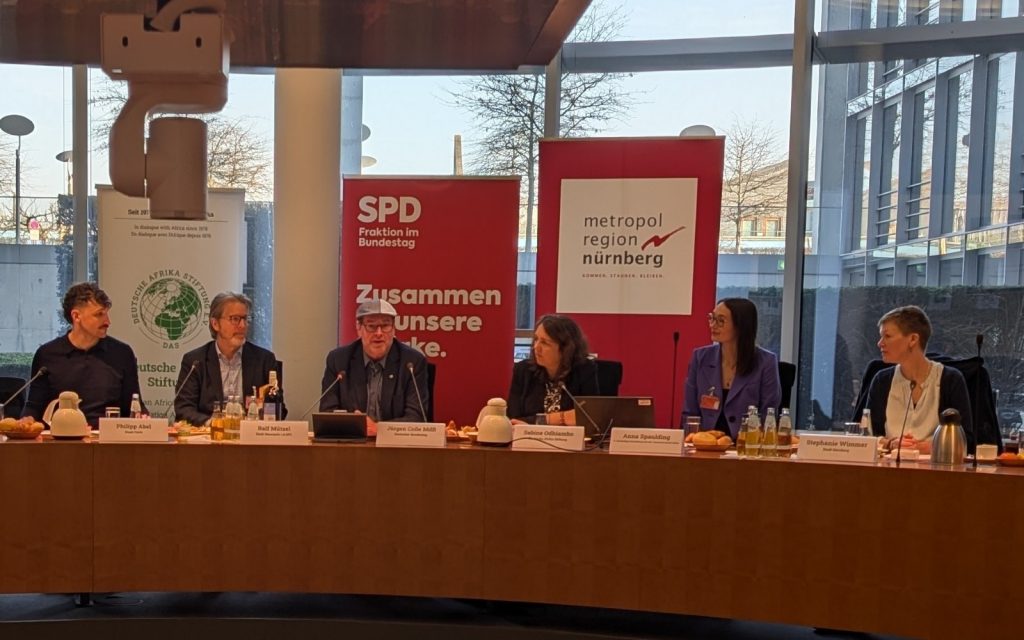
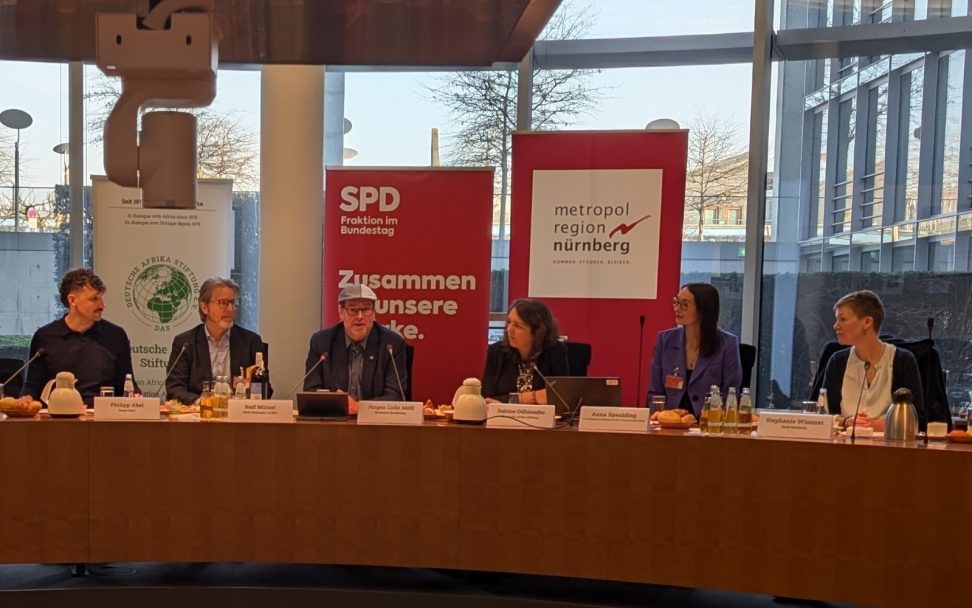
These and other questions were the core of the parliamentary breakfast hosted by Jürgen Coße MP in collaboration with the German Africa Foundation and the Initiative Group for Sustainable Development and Economic Cooperation in Africa of the Nuremberg Metropolitan Region.
Programme
Welocme Remarks:
Jürgen Coße MP, Spokesperson for Local Government Affairs for the SPD Parliamentary Group, Chair of the SPD Africa Discussion Group, and Member of the Board of the German Africa Foundation
Presentations:
“The Initiative Group for Sustainable Development and Economic Cooperation in Africa”: Anna Spaulding, Head of the Initiative Group for Sustainable Development and Economic Cooperation in Africa for the Nuremberg Metropolitan Region
“Local Expertise in the Implementation of Development Projects”: Ralf Mützel, Head of the Office for Sustainability for the City of Neumarkt i.d.OPf.
“Involving the Diaspora in Cooperation”: Stephanie Wimmer, Togo Partnership Officer at the Office of the Mayor of Nuremberg
“The Local Government’s Role as a Multiplier and Link, and the Practical Implementation of Federal Programs”: Philipp Abel, Head of the Sustainability Office of the City of Fürth
Closing Remarks:
Jürgen Coße MP, Spokesperson for Local Government Affairs for the SPD Parliamentary Group, Chair of the SPD Africa Discussion Group, and Member of the Board of the German Africa Foundation
Moderation:
Sabine Odhiambo, Secretary General, German Africa Foundation