Copper, cobalt, lithium and other strategic raw materials are at the heart of the global energy and industrial transformation. The Democratic Republic of the Congo and Zambia are among the world’s most important producer countries. For both countries, a key question is how these resources can be harnessed to advance their own economic development, industrialisation and regional integration. Against this backdrop, both access to international markets and the development of strategic supply chains are receiving increasing attention. At the same time, these issues are shaping international geopolitical debates.
The Lobito Corridor is of particular significance in this context. Connecting the Angolan port of Lobito via the Benguela Railway with the Congolese-Zambian Copperbelt region, it could complement existing transport routes through Southern and Eastern Africa and facilitate new trade and logistics flows. The project has gained additional momentum through the support of international partners. In particular, the European Union has designated the Lobito Corridor as one of the flagship projects of its Global Gateway strategy and is supporting the expansion of transport and economic links along the route through investments amounting to EUR 1.68 billion by 2027. The corridor is therefore far more than a logistics infrastructure project: it raises questions of regional integration and economic transformation, as well as issues relating to raw-material security and international competition over strategic supply chains.
The study “Corridor de Lobito: La reconfiguration géopolitique des flux de transport des minerais de la RDC et de la Zambie” by Prof. Dr Jean-Pierre Mpiana Tshitenge, Professor of Sociology at the University of Kinshasa, was supported by the Konrad-Adenauer-Stiftung in the Democratic Republic of the Congo. It analyses these developments from historical, geopolitical and geoeconomic perspectives. The study examines the roles of the Democratic Republic of the Congo, Zambia and Angola, the existing mineral export corridors, the revival of the Lobito Corridor, and the related financing, governance and development issues.
What economic and development-policy interests are Angola, the Democratic Republic of the Congo and Zambia pursuing through the expansion of the Lobito Corridor? What impact could the corridor have on trade in strategic raw materials and on existing transport routes and supply chains in Southern Africa? How does the project relate to the infrastructure and raw-material strategies of China, the United States and the European Union? Under what conditions can the Lobito Corridor become a “development corridor” that creates sustainable economic prospects for the region beyond the extractive export of raw materials? And what contribution can Germany and Europe make in this regard?
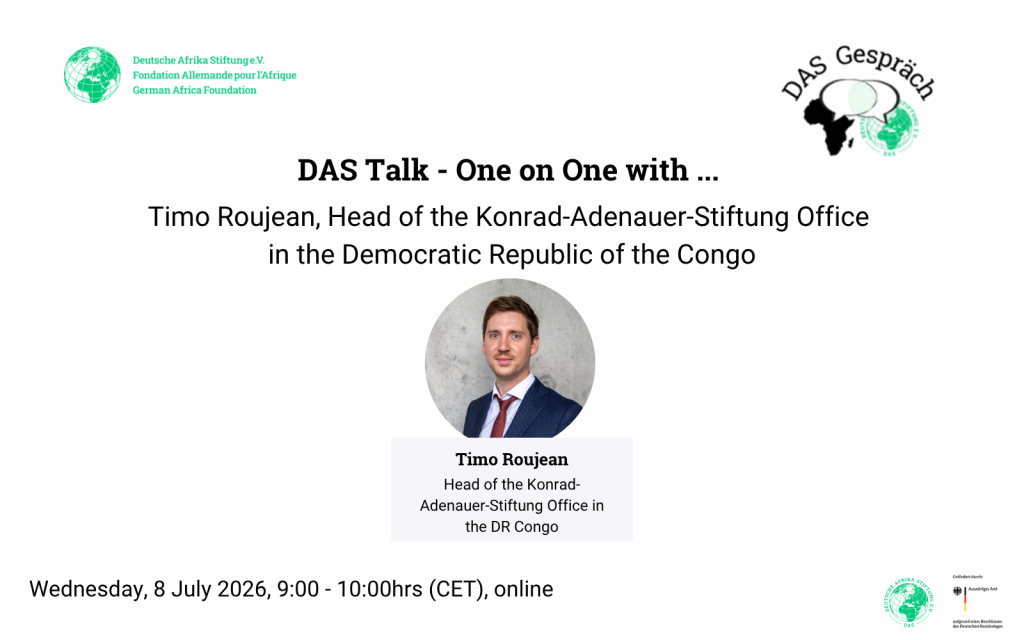
We discussed these and other questions with Timo Roujean, Director of the Konrad-Adenauer-Stiftung’s Office in the Democratic Republic of the Congo, as part of DAS Talk.
You are currently viewing a placeholder content from YouTube. To access the actual content, click the button below. Please note that doing so will share data with third-party providers.
About the Guest
Timo Roujean
Timo Roujean has headed the Konrad-Adenauer-Stiftung’s Country Office in the Democratic Republic of the Congo (DR Congo) since October 2025. Before joining the Foundation, he worked at the Munich Security Conference. Prior to his university studies, he gained practical experience in Kolwezi in south-eastern DR Congo through a weltwärts voluntary service programme, working at a secondary school and a health centre for children.He studied Politics and Public Administration at the Universities of Konstanz and Tallinn, as well as Peace Research and International Relations at the University of Tübingen, Sciences Po Paris and Muscat University for Sharia Sciences in Oman. His areas of expertise include resource conflicts in the Global South, mediation and interreligious dialogue. As part of his master’s thesis, he conducted field research on resource conflicts in Katanga, DR Congo.